The first gray hairs start an argument with the mirror that usually ends at a salon in Pineville, and the stylist's first question surprises people: do you want the gray gone, or do you want it quieter? Those are two different services, with different chemistry, different appointments, and very different relationships with your calendar. Coverage and blending get lumped together as coloring the gray, but choosing between them is really choosing how you want the next three months to look.
What full coverage does
Coverage uses permanent color to make every strand the target shade, gray included. Gray hair is not just hair without pigment; its texture is often coarser and its cuticle tighter, which makes it resistant, so covering it reliably is a formulation job rather than a rinse. The result is a clean, uniform color with no gray visible anywhere. The cost of that uniformity shows up at the roots: as hair grows, roughly half an inch a month, the new gray arrives in a visible line against the colored hair, and the line does not negotiate. Most coverage clients settle into a four-to-six-week rhythm to keep the line from announcing itself.
What blending does
Blending takes the opposite approach. Instead of erasing the gray, it lowers the contrast: demi-permanent color, lowlights, or highlights woven through so the gray reads as one tone among several rather than a separate color growing in. Nothing is fully opaque, so nothing grows out with a hard edge. The gray is still there on close inspection, but it stops being the first thing the eye finds. Blending fades gradually rather than growing out, which stretches appointments further apart and makes it the forgiving option for people whose schedules slip.
| Full coverage | Blending | |
|---|---|---|
| Gray after service | None visible | Softened, still present |
| Grow-out | A clear line at the roots | No hard line, gradual fade |
| Typical rhythm | Every 4 to 6 weeks | Every 8 to 12 weeks |
| Best for | A polished, uniform shade | A low-maintenance, natural read |
| Changing your mind | Growing it out is a long project | Easy to deepen or let fade |
Choosing with your actual life
The honest deciding question is not how you feel about gray. It is how you feel about appointments. Coverage rewards people who like a standing date in the book and a consistently finished look, and punishes anyone who regularly cancels, because two missed cycles turn the root line into a band. Blending rewards the opposite temperament. It also suits hair that is only partly gray, where covering everything to hide a scattering of strands sacrifices a lot of natural color for a small problem.
There is a middle path many clients take without naming it: cover fully while the gray percentage is low and the line is easy to keep, then shift strategy toward blending in later years when the gray is winning anyway. Framing it as a sequence, rather than a permanent identity, makes the first decision much easier.

How much gray you have changes the answer
Percentage matters as much as preference. At a light scattering, mostly at the temples and part, blending is usually plenty, because the eye reads the overall color and the few bright strands register as dimension. Past roughly half gray, blending still works, but the effect is a salt-and-pepper softness rather than a return to your old shade, and some people love exactly that while others feel it reads as giving up. Past that point, full coverage is the only route to a single uniform color, which is why the decision often revisits itself every few years as the percentage climbs. A good stylist will tell you honestly which side of those lines your hair sits on today, under salon light, rather than letting you order a service aimed at a head of hair you no longer have.
A note on texture
Gray hair often arrives wirier than the hair it replaces, and in Pineville's humid summers wiry gray at the hairline can frizz in a way that draws the eye more than the color does. Whichever plan you choose, ask your stylist about the texture half of the problem: the right cut, a smoothing product at the hairline, or a texturizing service are separate tools, and fixing the texture sometimes quiets the gray more than the color does.
Common questions
Can I switch from coverage to blending later?
Yes, though it is a transition rather than a single appointment. A stylist typically weaves highlights or lowlights through the colored hair over a visit or two so the line softens as it grows out.
Why does my covered gray look dull faster than the rest?
Resistant gray hair can take color unevenly and lose it sooner, especially at the hairline where washing and sun hit hardest. Your stylist can adjust the formula and the refresh rhythm for those areas.
Which option looks better in photos?
Coverage gives the most uniform result, which photographs cleanest. Blending looks more dimensional in person. The better choice is the one you will actually maintain between appointments.
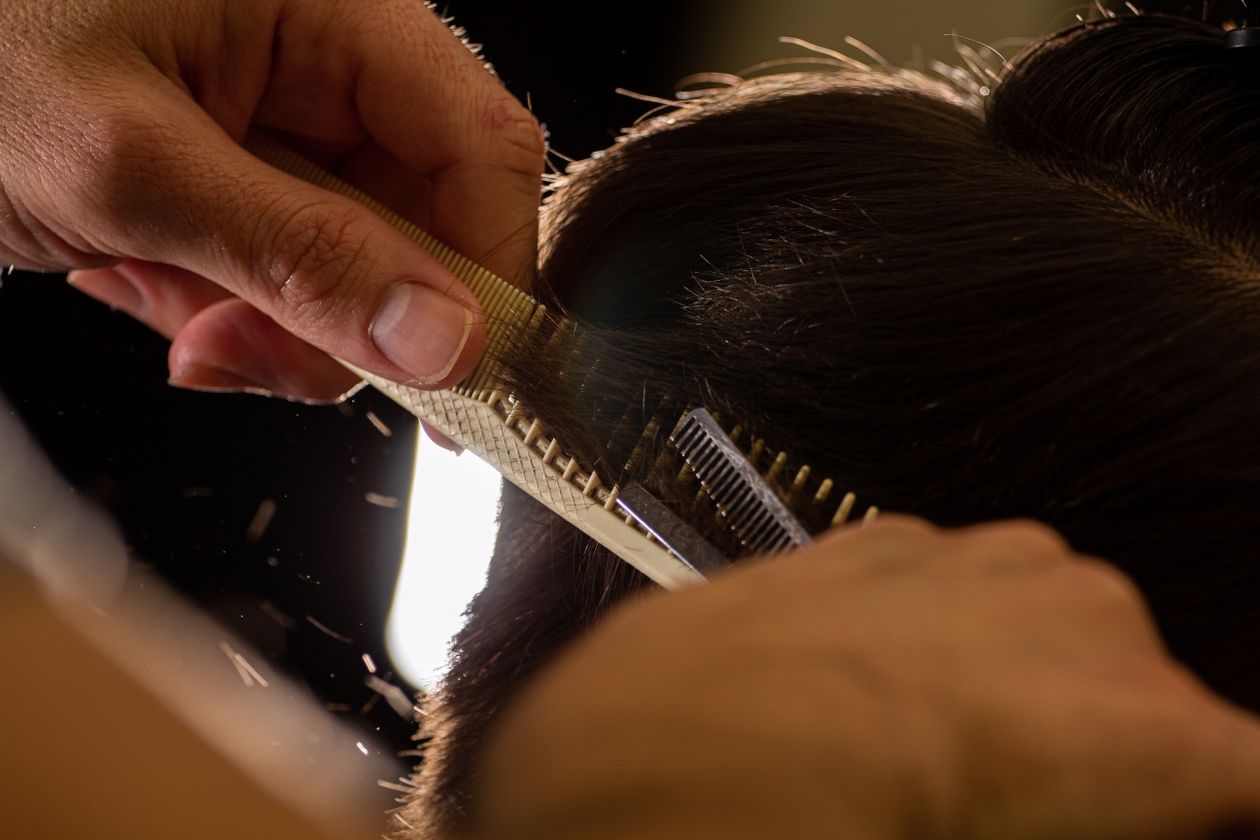
Photos in this guide are representative stock images.
← All guides from Studio 321← Back to Studio 321